
Upneeq

Are you struggling with low-lying lids? Viata Aesthetics and Wellness has the solution for big beautiful eyes. One drop of Upneeq. Upneeq is the only FDA-approved prescription eyedrop for acquired ptosis (low-lying lids) that lifts your upper eyelids to open your eyes.
If you’ve noticed that your eyes look tired—more tired than you feel—you may have acquired blepharoptosis (low-lying lids), also called ptosis. With this condition, the upper eyelids droop, most commonly because of progressive weakening of the eyelid muscles over time. Acquired ptosis may make you look sleepy or even obstruct your vision as it progresses.

Put one drop in each affected eye, as directed. If you wear contacts, be sure to remove them first (you can put them back in 15 minutes after application).
Close your eyes for 60 seconds after application for best results.
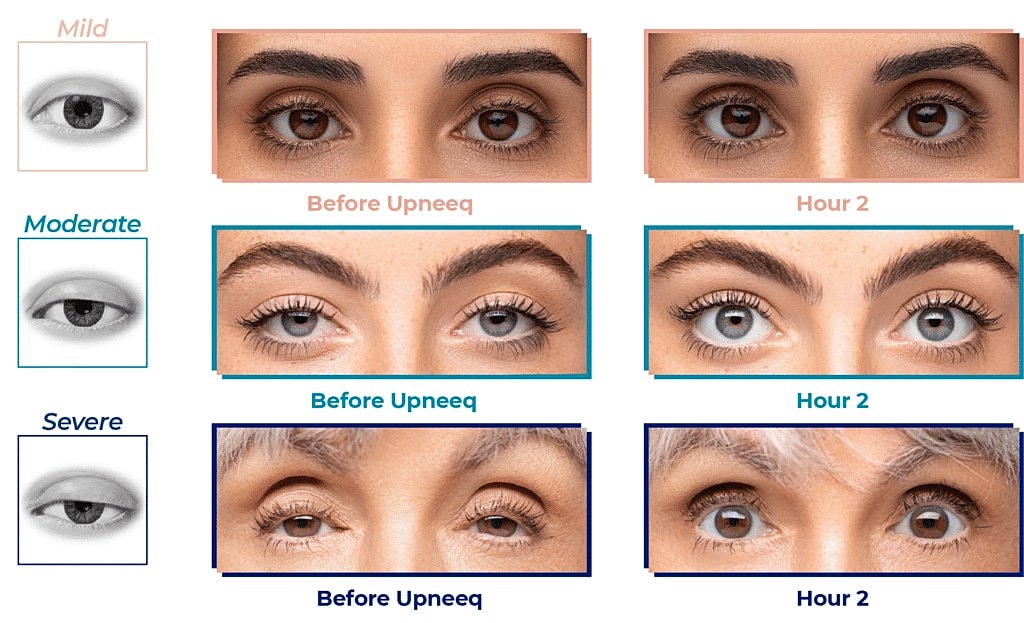
Some people see a lift in as little as 5 minutes, but it may take 2 hours to see full results.
Enjoy your bright, bold, revitalized eyes! Results last 6–8 hours.
Contact Viata Aesthetics and Wellness in Katy by scheduling a Consultation or Appointment. Our trained staff will help explain how the whole process works.
Upneeq® (oxymetazoline hydrochloride ophthalmic solution), 0.1% is a prescription eye drop used to treat acquired ptosis in adults.
Acquired ptosis, also known as low-lying lids, is a common condition that occurs when the muscles in the eyelid stretch and weaken, causing the top eyelid to drop.
Acquired ptosis affects adults of all ages, but occurs more often with increased age. Acquired ptosis can also be a result of cataract surgery, contact lens wear, or an underlying medical condition. It’s not uncommon for patients to have acquired ptosis in only one eye or in one eye more than the other.
Yes, Upneeq is the only FDA-approved prescription eye drop for acquired ptosis (low-lying lids). Upneeq was proven to be safe and effective when used as directed in clinical trials.
Common side effects (seen in 1–5% of patients) included eye inflammation, eye redness, dry eye, blurred vision, instillation site pain, eye irritation, and headache. For full safety information, see Important Safety Information here.
Apply Upneeq to your affected eye(s) in two easy steps:
If you wear contact lenses, remove them before instilling Upneeq eye drops. You may put them back in 15 minutes after administering Upneeq.
If more than one medication or eye drop is being used in the eye, they should be administered at least 15 minutes apart.
Patients see maximum results within 2 hours, but results may be seen as soon as 5–15 minutes.
Most patients in clinical trials had a lift in their eyelids for 6–8 hours.
Upneeq should only be used as prescribed: one drop in the affected eye(s), once daily. It should not be used more than once a day. For results to continue, it must be used every day.
One dose is one drop of liquid in one or both eyes, depending on need. There is extra product in the vial in case you miss your eye the first time—it happens! Discard vial after use.
Ptosis ranges from mild to moderate to severe, depending on how much your eyelid covers your iris. There are specific mm measurements that determine level of severity. Below is a photo of varying degrees of ptosis; (A) normal, (B) mild, (C) moderate, and (D) severe:
Upneeq is proven to work on all levels of acquired ptosis. Upneeq is not effective for congenital ptosis. Please note that this scale is for preliminary assessment only. Your provider will make the final assessment of your ptosis.
Low-lying eyelids can impact your field of vision or general appearance. Low-lying lids may lead to issues with:
Ro and its affiliated provider practices do not accept insurance and are cash-pay only.